Environmental Curvature Response in Planetary Dynamics: Solar System Diagnostics of the κ-Framework
Abstract
The κ-framework proposes that spacetime curvature responds not only to mass but also to properties of the surrounding dynamical environment. In previous work, titled “An Environmental Curvature Response for Galaxy Rotation Curves: Empirical Tests of the κ-Framework using the SPARC Dataset,” the framework was evaluated against the SPARC rotation-curve database and shown to reproduce observed galaxy rotation profiles without invoking non-baryonic dark matter.
Any modification to gravitational dynamics must also remain consistent with the extremely well-constrained dynamical environment of the Solar System. Planetary motion provides a sensitive probe of weak perturbative forces through long-term orbital stability and secular perihelion motion.
The present study evaluates the κ-framework in the context of planetary Solar System dynamics using high-precision N-body integrations with the REBOUND integrator. Orbital stability, secular drift, and perihelion motion are examined for representative planets spanning the inner, middle, and outer Solar System.
Across all tested configurations the κ-framework produces extremely small structural perturbations to planetary orbits while introducing a measurable secular rotation of the perihelion direction. Parameter sweeps reveal three dynamical regimes: a stable regime with negligible orbital deformation, a transitional regime with increasing apsidal motion, and an unstable regime in which orbits diverge.
These results indicate that the κ-framework perturbation can remain dynamically consistent with planetary Solar System behaviour within a weak forcing regime while producing measurable dynamical signatures.
1. Introduction
The behaviour of galaxy rotation curves has long represented a central empirical challenge for gravitational theory. The κ-framework proposes that curvature may respond not only to mass but also to properties of the surrounding dynamical environment.
Empirical tests of the framework against the SPARC rotation-curve database demonstrated that a κ-dependent velocity prescription reproduces observed galactic velocity structure across a broad range of galaxies. While galaxy-scale behaviour provides one class of test, any modification to gravitational dynamics must also remain compatible with the highly constrained dynamical environment of the Solar System.
Planetary motion offers a particularly sensitive probe of weak perturbative forces. Small deviations from Newtonian behaviour accumulate over time through secular drift of orbital elements, especially the orientation of the orbital ellipse.
The purpose of the present work is therefore to evaluate whether the κ-framework introduces detectable perturbations in planetary dynamics while preserving long-term orbital stability.
2. Numerical Method
2.1 N-body integration
Simulations were performed using the REBOUND N-body integrator with the adaptive high-accuracy IAS15 integrator.
The simulated system consists of the Sun and the eight major planets:
Sun, Mercury, Venus, Earth, Mars, Jupiter, Saturn, Uranus, Neptune
Initial conditions are obtained from the built-in Solar System objects distributed with REBOUND.
Simulation units are:
- Astronomical Units (AU)
- days
- solar masses (M☉)
Each integration spans 200 years with 4000 sampling steps. Energy conservation diagnostics are monitored throughout each simulation.
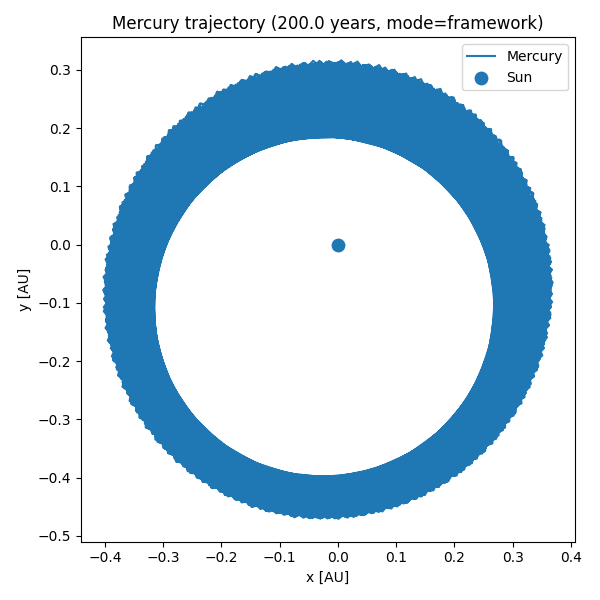
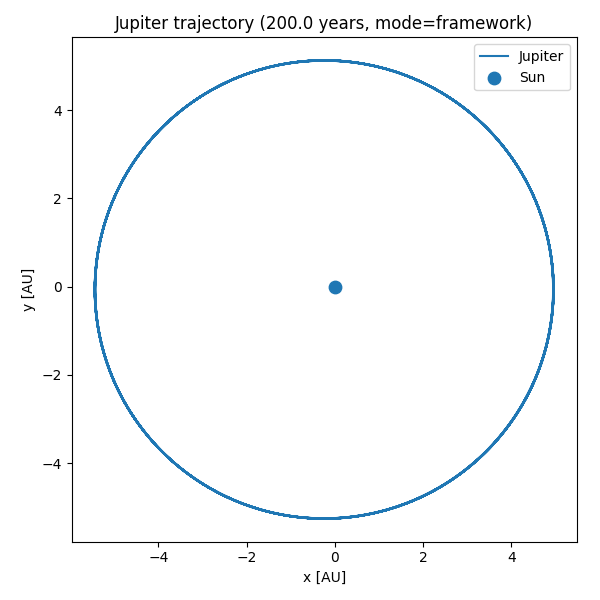
Figures 1 & 2: Newtonian baseline integration of representative planetary orbits using the REBOUND IAS15 integrator. Mercury (inner orbit) and Jupiter (outer orbit) illustrate the range of orbital scales and eccentricities present in the planetary Solar System. The simulations remain dynamically stable over the 200-year integration period.
2.2 κ-framework perturbation
The κ-framework introduces an additional curvature response term dependent on environmental properties including density and dynamical strain. For the Solar System tests presented here the environmental density is fixed at
while the strain-rate parameter is varied across several orders of magnitude in order to map the dynamical response of the system.
Simulations are performed both with and without the κ perturbation so that orbital diagnostics may be evaluated relative to the Newtonian baseline.
3. Orbital Diagnostics
A range of orbital quantities is monitored during each integration:
- orbital radius
- velocity residuals
- radial acceleration residuals
- semi-major axis
- eccentricity
- orbital phase
- perihelion orientation
These diagnostics allow identification of both structural orbital deformation and secular dynamical drift.
3.1 Perihelion estimation
Two independent methods are used to estimate apsidal motion:
- the classical argument of perihelion (ω) obtained from orbital elements
- the direction of the Laplace-Runge-Lenz (LRL) vector
Agreement between the two estimators provides an internal consistency check on the measurement of perihelion drift.
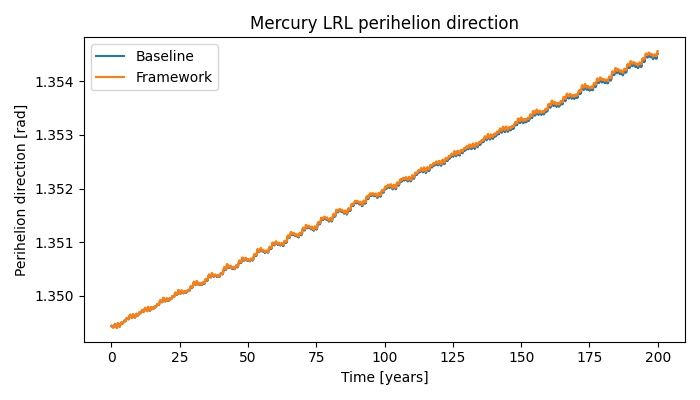
Figure 3: Mercury perihelion direction comparison: Comparison of the perihelion direction inferred from the Laplace-Runge-Lenz (LRL) vector for the Newtonian baseline and the κ-framework simulation over a 200-year integration. The near overlap of the two curves indicates that the κ perturbation produces only a very small secular deviation from the Newtonian orbital orientation.
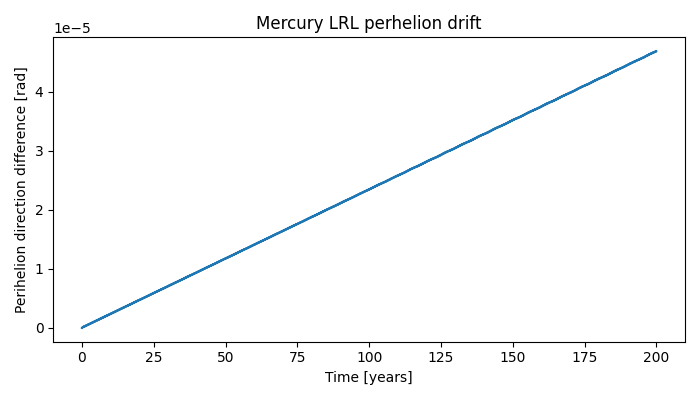
Figure 4: Secular perihelion drift of Mercury: Accumulated difference in the perihelion direction derived from the LRL vector between the Newtonian baseline and the κ-framework simulation. The ~linear trend indicates a slow secular rotation of the orbital ellipse while the overall orbital structure remains essentially unchanged
4. Parameter Sweeps
Parameter sweeps are performed across environmental strain-rate values in order to examine the dynamical response of the planetary system. Three dynamical regimes emerge:
- Safe regime
Orbital deviations remain extremely small and the system behaves essentially Newtonian. - Distorted regime
Apsidal motion increases while orbital elements begin to show visible deformation. - Unstable regime
Orbital divergence occurs and the notion of a coherent precession rate becomes ill-defined.
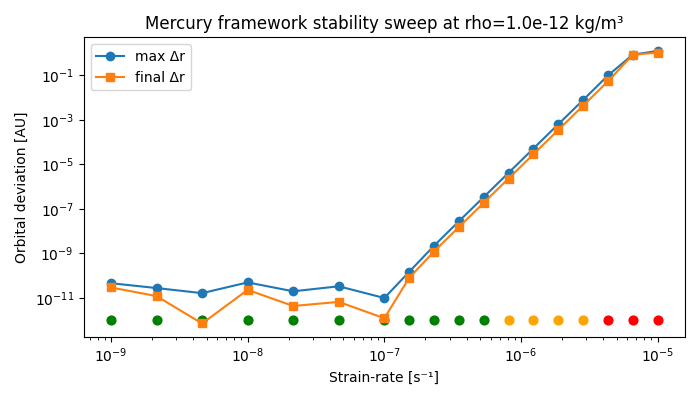
Figure 5: Mercury orbital deviation as a function of environmental strain-rate: Maximum and final orbital deviation relative to the Newtonian baseline for Mercury over a 200-year integration. Three dynamical regimes are visible: a stable regime in which orbital deviations remain negligible, a transitional regime with increasing perturbation, and an unstable regime in which the orbit diverges. The onset of measurable dynamical deviation occurs well after the weak-perturbation regime explored in the present Solar System tests.
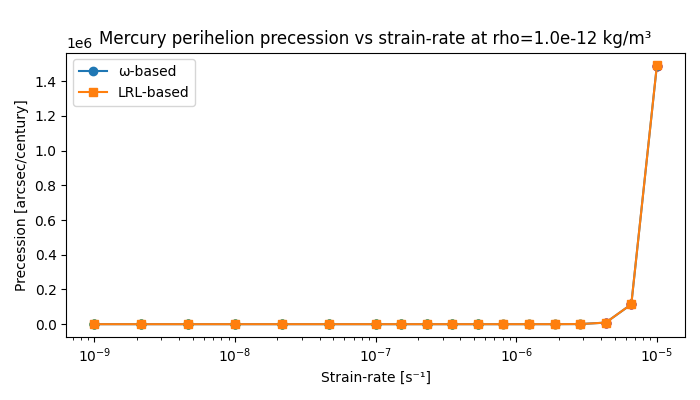
Figure 6: Mercury perihelion precession as a function of environmental strain-rate: Estimated perihelion precession rate for Mercury derived from both the angular momentum (ω-based) method and the Laplace-Runge-Lenz (LRL) vector method as a function of the κ-framework strain-rate parameter for a fixed density . In the low-strain regime relevant to Solar System conditions, the predicted precession remains extremely small and the two independent diagnostics agree closely. Rapid growth in precession occurs only when the strain-rate approaches values where the orbital solution itself becomes dynamically unstable.
5. Planetary Results
Three representative planets are examined:
- Mercury - inner Solar System
- Earth - intermediate orbit
- Jupiter - outer giant planet
These planets sample a wide range of orbital radii and dynamical environments. Across all tested runs the same qualitative behaviour is observed. Within the weak forcing regime
- Δa ≲ 10⁻¹¹ AU
- Δe ≲ 10⁻¹⁰
indicating negligible structural alteration of the orbit. Despite the extremely small orbital deformation, a measurable secular drift of the perihelion direction is detected. Example values at
- ρ = 10⁻¹² kg m⁻³
- strain-rate ≈ 5.3 x 10⁻⁷ s⁻¹
are approximately
- Mercury ≈ 0.03 arcsec per century
- Earth ≈ 0.05 arcsec per century
- Jupiter ≈ 0.13 arcsec per century
The perihelion motion estimated from orbital elements and from the LRL vector is found to agree closely across all runs.
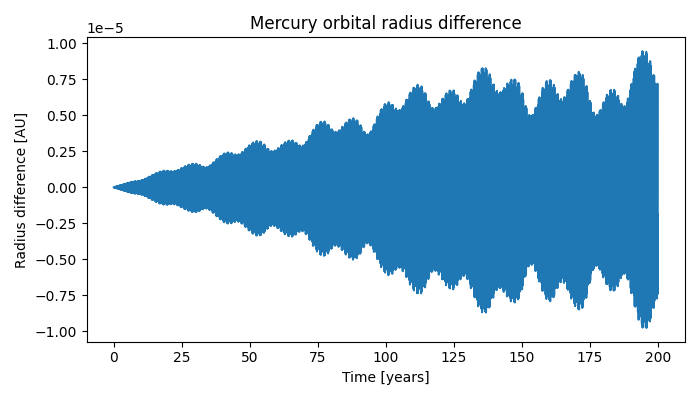
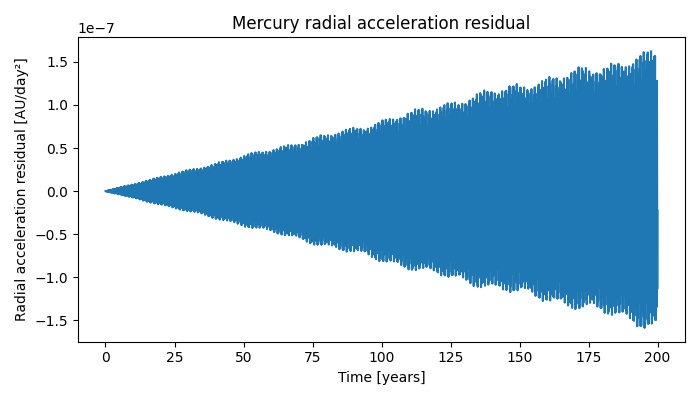
Figures 7 & 8: Mercury orbital diagnostics: Residual diagnostics for Mercury comparing the Newtonian baseline and the κ-framework simulation over a 200-year integration. Panels show the difference in orbital radius and radial acceleration relative to the Newtonian solution. The results demonstrate that within the low-strain regime relevant to Solar System conditions, the κ-framework produces only extremely small perturbations to Mercury's Keplerian orbit while allowing a slow secular rotation of the orbital ellipse.
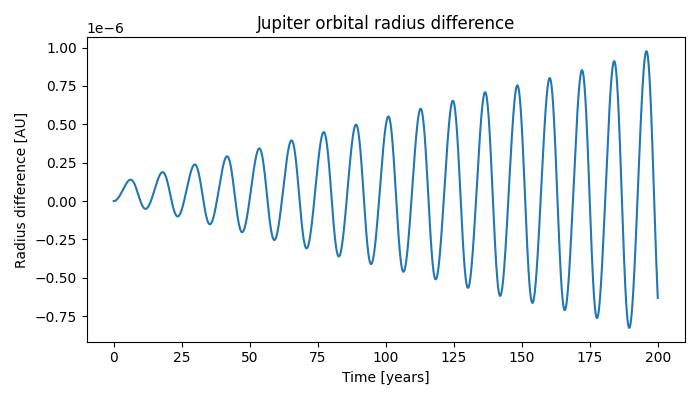
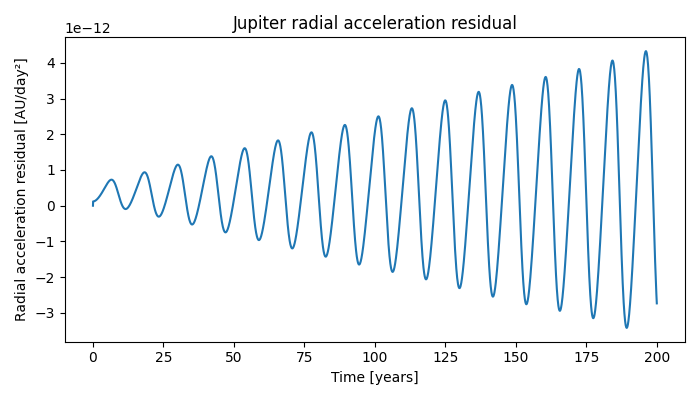
Figures 9 & 10: Jupiter orbital diagnostics: Residual diagnostics for Jupiter comparing the Newtonian baseline and the κ-framework simulation over a 200-year integration. Panels illustrate deviations in orbital radius and radial acceleration relative to the Newtonian solution. Despite Jupiter's large orbital radius and dominant planetary mass, the κ-framework perturbation remains extremely small in the Solar System regime examined, indicating that planetary-scale dynamics remain essentially unchanged.
6. Interpretation
The κ-framework perturbation behaves as an extremely weak additional force within the Solar System environment.
The principal dynamical signature is not large deformation of orbital parameters but rather a slow secular rotation of the orbital ellipse.
This behaviour appears consistently across planets spanning the inner and outer Solar System and occurs well before the onset of orbital instability in parameter sweeps.
7. Limitations
The present analysis models the planetary Solar System consisting of the Sun and eight planets.
Satellite systems, including the Earth–Moon system and the Galilean moons of Jupiter, are not included in the present integrations. Such tightly coupled multi-body environments provide additional sensitive probes of dynamical perturbations and represent a natural extension of the present work.
Relativistic corrections are also not included in the present simulations, as the focus here is the relative comparison between Newtonian and κ-framework dynamics.
8. Conclusion
High-precision N-body integrations of the planetary Solar System demonstrate that the κ-framework can produce measurable perihelion motion while leaving the overall structure of planetary orbits essentially unchanged in the weak forcing regime.
Parameter sweeps reveal distinct stability regimes in which measurable apsidal motion appears prior to catastrophic orbital divergence.
The results presented here indicate that an environmental curvature response of the form proposed in the κ-framework can reproduce galaxy-scale phenomenology while remaining consistent with Solar System dynamics in the weak-field regime.
Further work will be required to explore the behaviour of the framework in more complex gravitational systems, including multi-body environments and galactic structure formation. Incorporating satellite systems and longer integration horizons will provide further constraints on the framework.
References
SPARC: Mass Models for 175 Disk Galaxies with Spitzer Photometry and Accurate Rotation Curves
Lelli, F., McGaugh, S. S., & Schombert, J. M. (2016)
https://arxiv.org/abs/1606.09251The Radial Acceleration Relation in Rotationally Supported Galaxies
McGaugh, S. S., Lelli, F., & Schombert, J. M. (2016)
https://arxiv.org/abs/1609.05917A modification of the Newtonian dynamics as a possible alternative to the hidden mass hypothesis
Milgrom, M. (1983)
https://ui.adsabs.harvard.edu/abs/1983ApJ...270..365M/abstractA Universal Density Profile from Hierarchical Clustering
Navarro, J., Frenk, C., & White, S. (1997)
https://ui.adsabs.harvard.edu/abs/1997ApJ...490..493N/abstractRotational properties of 21 Sc galaxies with a large range of luminosities and radii
Rubin, V. C., Ford, W. K., & Thonnard, N. (1980)
https://ui.adsabs.harvard.edu/abs/1980ApJ...238..471R/abstractRotation Curves of Spiral Galaxies
Sofue, Y., & Rubin, V. (2001)
https://arxiv.org/abs/astro-ph/0010594Modified Newtonian Dynamics (MOND): Observational Phenomenology and Relativistic Extensions
Famaey, B., & McGaugh, S. (2012)
https://arxiv.org/abs/1112.3960Planck 2018 results. VI. Cosmological parameters
Planck Collaboration (2020)
https://arxiv.org/abs/1807.06209Thermodynamics of spacetime: The Einstein equation of state
Jacobson, T. (1995)
https://journals.aps.org/prl/abstract/10.1103/PhysRevLett.75.1260REBOUND: an open-source multi-purpose N-body code for collisional dynamics.
Rein, H., & Liu, S.-F. (2012)
https://arxiv.org/abs/1110.4876IAS15: a fast, adaptive, high-order integrator for gravitational dynamics.
Rein, H., & Spiegel, D. S. (2015)
https://arxiv.org/abs/1409.4779An Environmental Curvature Response for Galaxy Rotation Curves: Empirical Tests of the κ-Framework using the SPARC Dataset
Pickett, J. (2026)
https://doi.org/10.55277/researchhub.53yst6oa.1
Further Reading

Code and Reproducibility
The analysis pipeline used in this study is implemented in Python and performs REBOUND-based N-body integrations of the planetary Solar System. All code used to generate the figures and statistical results presented in this work is available as open-source software:
github.com/hasjack/OnGravity/tree/feature/solar-system-model/python/solar-system
This repository includes the full analysis pipeline, data ingestion routines, model fitting procedures, and scripts used to generate the figures presented in this paper.

Please consider funding this research on Research Hub

Content on this site is licensed under a Creative Commons Attribution 4.0 International License