An Environmental Curvature Response for Galaxy Rotation Curves: Empirical Tests of the κ-Framework using the SPARC Dataset
Abstract
Galaxy rotation curves systematically deviate from the predictions of Newtonian gravity when only baryonic mass components are considered. The conventional interpretation introduces dark matter halos to reconcile these discrepancies. In this work an alternative empirical description is explored in which the Newtonian velocity field is modified by a multiplicative environmental response term characterised by a curvature parameter κ. The framework expresses the observed velocity profile as
Using the SPARC galaxy rotation curve dataset, empirical κ profiles are computed directly from observed and baryonic Newtonian velocities. Investigation then looks at whether κ can be described by simple environmental functions of baryonic dynamical quantities. Across 165 galaxies a linear relation between and , where is the baryonic acceleration found that systematically improves rotation-curve fits relative to baryons-only Newtonian predictions. A second model including baryonic shear provides a small additional improvement. Repeated train/test splits demonstrate that these relations generalise across the SPARC sample. The results suggest that a simple environmental curvature response may capture much of the phenomenology traditionally attributed to dark matter halos, and provide a new empirical framework for describing galaxy rotation curves.
Empirical κ profiles are extracted directly from observed rotation curves and stacked across the SPARC galaxy sample to explore environmental correlations. A simple predictive model relating κ to baryonic acceleration is then fitted and tested using repeated random train-test splits of the galaxy sample. The resulting model systematically improves rotation-curve fits relative to baryons-only Newtonian predictions for approximately 85-90% of galaxies in the SPARC dataset. These results suggest that galaxy rotation-curve discrepancies may be closely linked to baryonic dynamical properties through an environmental curvature response encoded in κ.
Introduction
The discrepancy between observed galaxy rotation curves and the predictions of Newtonian gravity based solely on baryonic mass has been a central problem in astrophysics for several decades. Observed rotation velocities remain approximately flat at large radii, whereas Newtonian predictions derived from luminous matter generally decline with distance from the galactic center. The prevailing interpretation attributes this discrepancy to extended dark matter halos surrounding galaxies.
Alternative approaches have attempted to modify the effective gravitational response in low-acceleration regimes. One prominent example is Modified Newtonian Dynamics (MOND), which introduces a characteristic acceleration scale at which the gravitational law transitions away from the Newtonian form.
This paper explores a different empirical approach. Rather than modifying the gravitational law directly, it is considered whether the observed velocity field can be represented as a Newtonian baryonic velocity multiplied by an environmental correction term. This correction is parameterised through a curvature-response variable κ that may depend on local dynamical properties of the baryonic system.
The κ-framework expresses the observed velocity profile as
where is the Newtonian circular velocity generated by baryonic mass components. The quantity κ(r) represents an environmental curvature response that modifies the effective velocity field.
The primary goal of this study is empirical: to determine whether can be described by simple environmental functions that systematically account for rotation-curve discrepancies across the SPARC galaxy sample.
Data
The analysis uses the SPARC (Spitzer Photometry and Accurate Rotation Curves) database, which provides high-quality rotation curves and baryonic mass models for nearby galaxies.
Each galaxy entry includes
- observed rotation velocities
- uncertainties on observed velocities
- baryonic mass model components derived from photometry
The baryonic mass model typically includes gas, stellar disk, and bulge contributions. The SPARC mass-model files contain columns such as
Rad Vobs errV Vgas Vdisk VbulSome files additionally provide a precomputed baryonic velocity .
The SPARC dataset currently contains more than 170 galaxies spanning a wide range of masses, morphologies, and dynamical environments.
Baryonic Newtonian Rotation Curves
The baryons-only circular velocity profile is constructed from the SPARC mass model components as
where and are the stellar mass-to-light ratios for the disk and bulge components. Common SPARC analyses yields:
- = 0.5
- = 0.7
If the SPARC data file provides directly, that value is used as the baryonic Newtonian velocity.
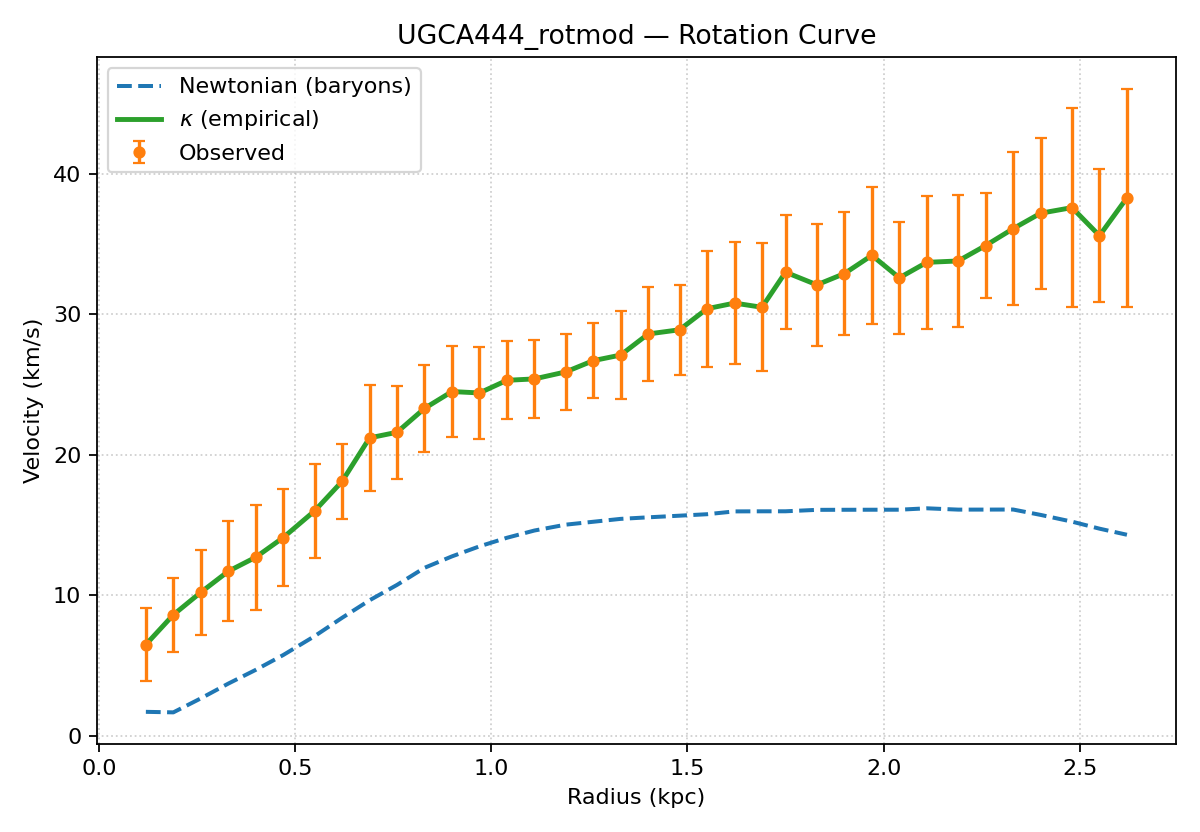
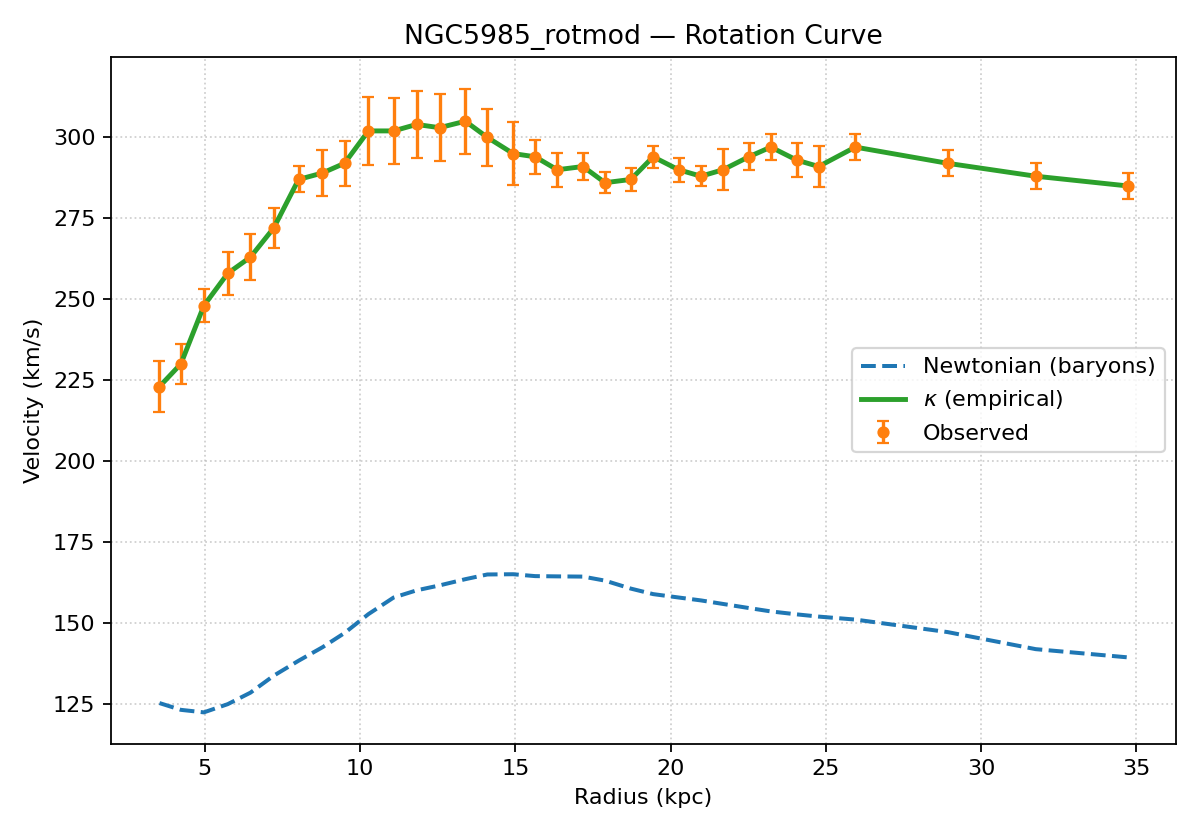
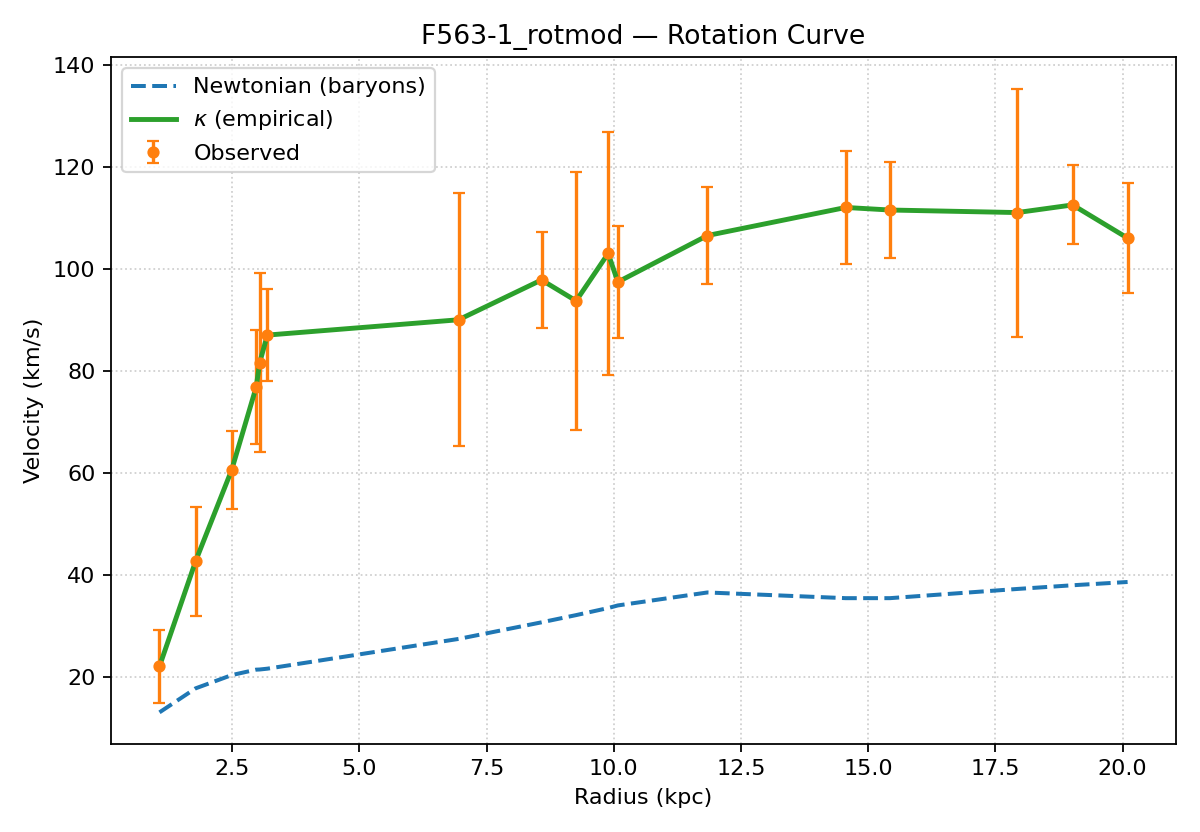
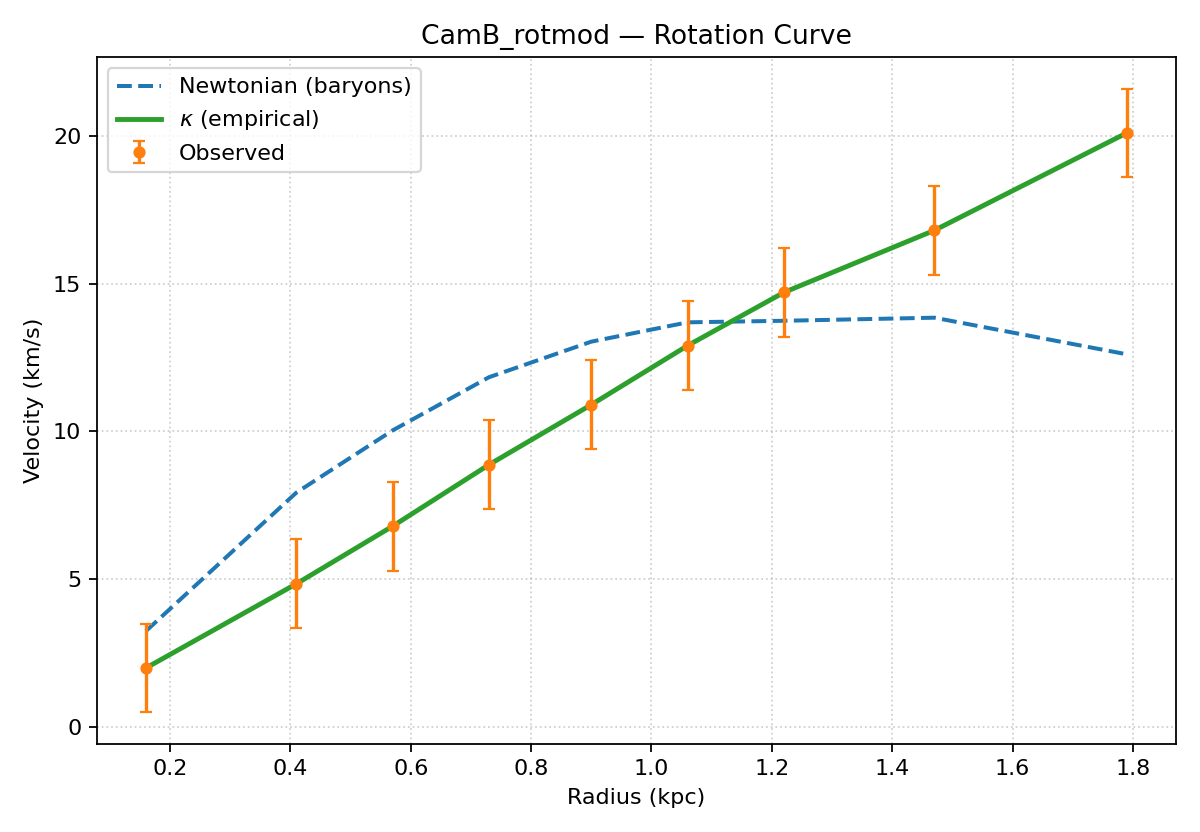
Figures 1-4: show representative rotation curves from the SPARC sample, including the baryonic Newtonian prediction, the observed velocities, and the κ-framework reconstruction.
Empirical κ Profiles
Given observed velocities and baryonic Newtonian velocities , the κ-framework relation
can be inverted to obtain an empirical estimate of :
For practical analysis the dimensionless quantity
is used, which directly represents the logarithmic discrepancy between observed and baryonic Newtonian velocities. This quantity can be computed for every radius in each galaxy rotation curve.
Environmental Quantities
To explore possible dependencies of , two baryonic dynamical quantities are considered. Baryonic acceleration is defined as
This quantity has been widely studied in rotation-curve phenomenology and appears prominently in the radial acceleration relation. Baryonic shear is estimated as the radial velocity gradient
computed from the baryonic velocity profile using a smoothed numerical derivative.
Empirical Stacking
Empirical values are computed for each radius in each SPARC galaxy. These measurements are then stacked across the full galaxy sample to explore possible correlations between
and several physical variables:
- radius
- normalised radius
- baryonic acceleration
- baryonic shear
Scatter plots of these relations allow visual identification of potential environmental dependencies.
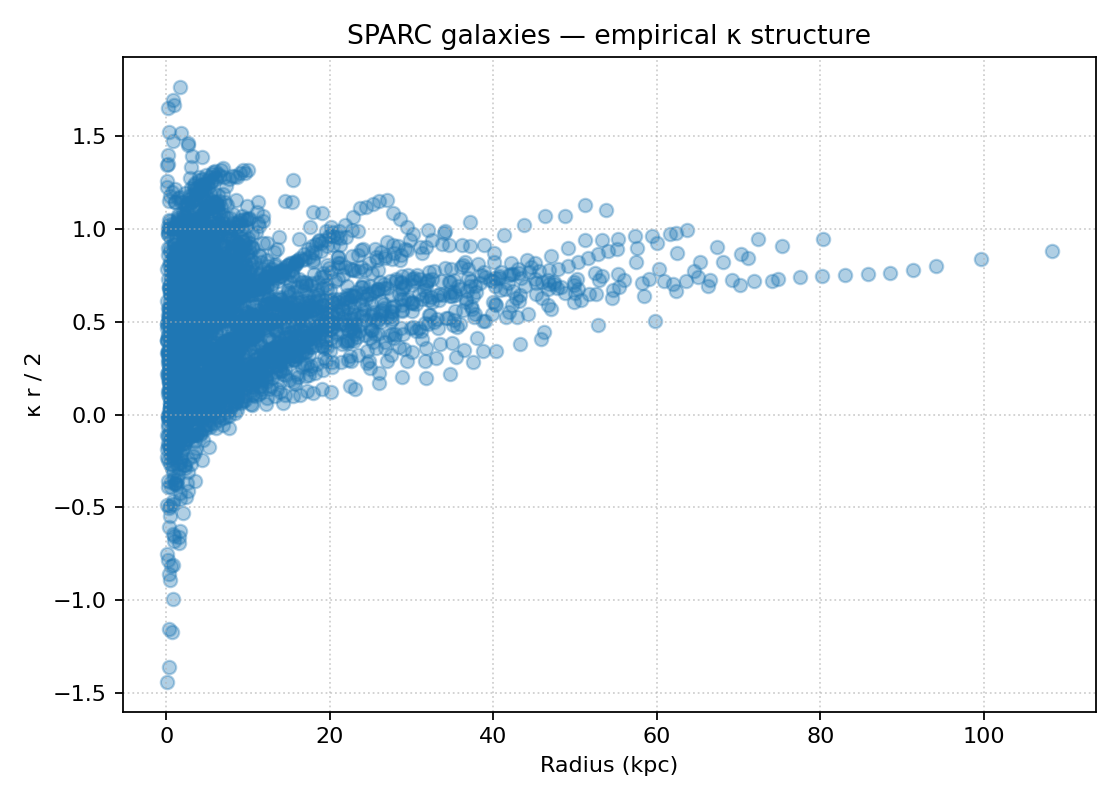
Figure 5: Empirical κ structure across the SPARC sample. Each point represents a measurement of κr/2 at a radius within a galaxy.
Predictive κ Models
Based on the observed correlations, simple predictive parameterisations of are tested. The first model assumes depends only on baryonic acceleration:
The second model additionally includes baryonic shear:
These models are fitted using least-squares regression on the training galaxy set.
Predicted velocities are then computed as
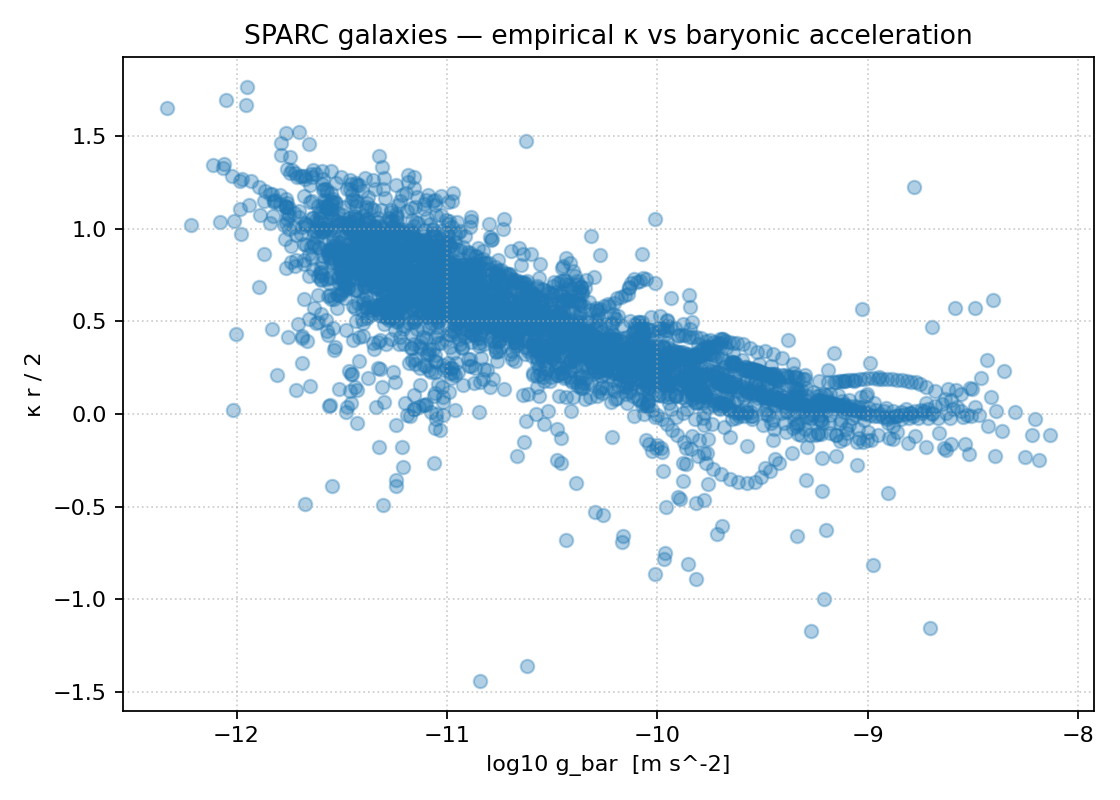
Figure 6: reveals a clear correlation between κr/2 and baryonic acceleration across the stacked SPARC sample.
Model Evaluation
Model performance is evaluated using the reduced statistic:
Three models are compared:
- baryons-only Newtonian prediction
- model
- model
To test robustness, the galaxy sample is repeatedly split into random training and test sets. Model parameters are fitted using the training galaxies and evaluated on the test galaxies.
Across repeated train/test splits the model improves the reduced relative to baryons-only predictions for ~90% of galaxies.
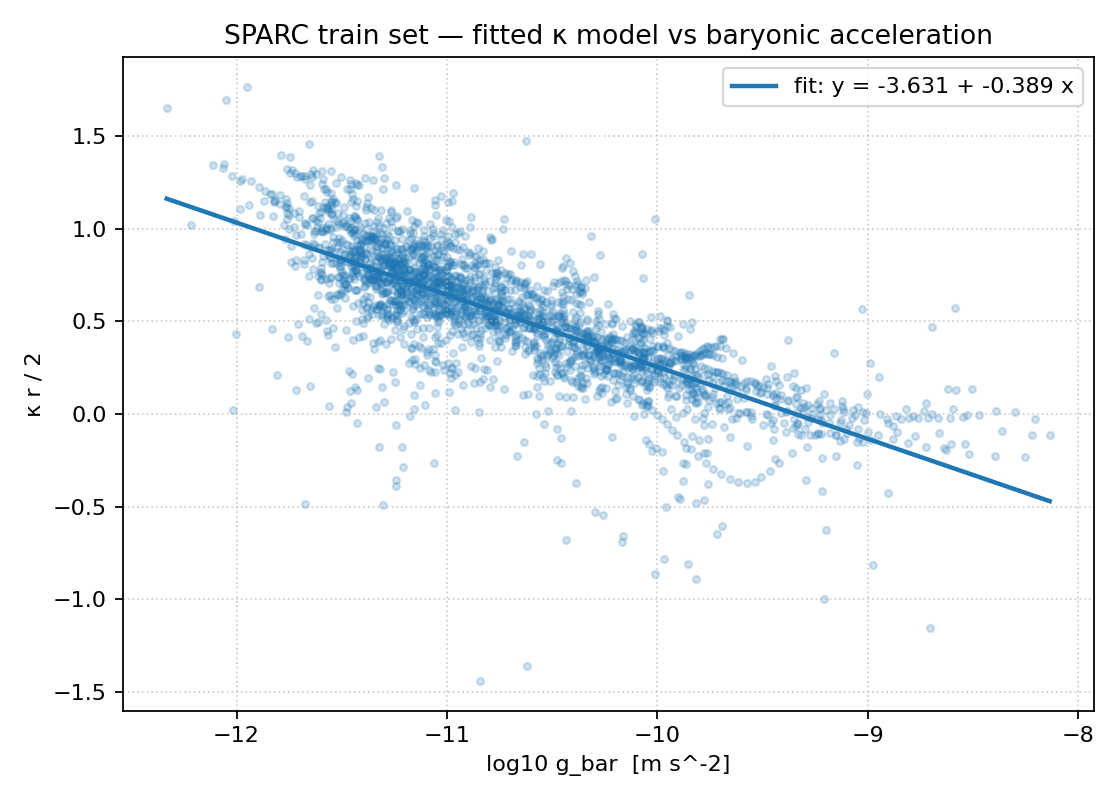
Figure 7: Linear regression fit describing the empirical relation between κr/2 and baryonic acceleration.
Across the SPARC sample the model improves the reduced relative to baryons-only predictions for a large fraction of galaxies. The inclusion of shear produces a modest additional improvement.
Relation to the Radial Acceleration Relation
The κ-framework predictions are also compared to the radial acceleration relation (RAR), which relates observed acceleration
to baryonic acceleration .
Residual diagnostics show that the κ-based predictions closely track the observed RAR trend, suggesting that the environmental curvature response encoded in may capture much of the phenomenology described by the RAR.
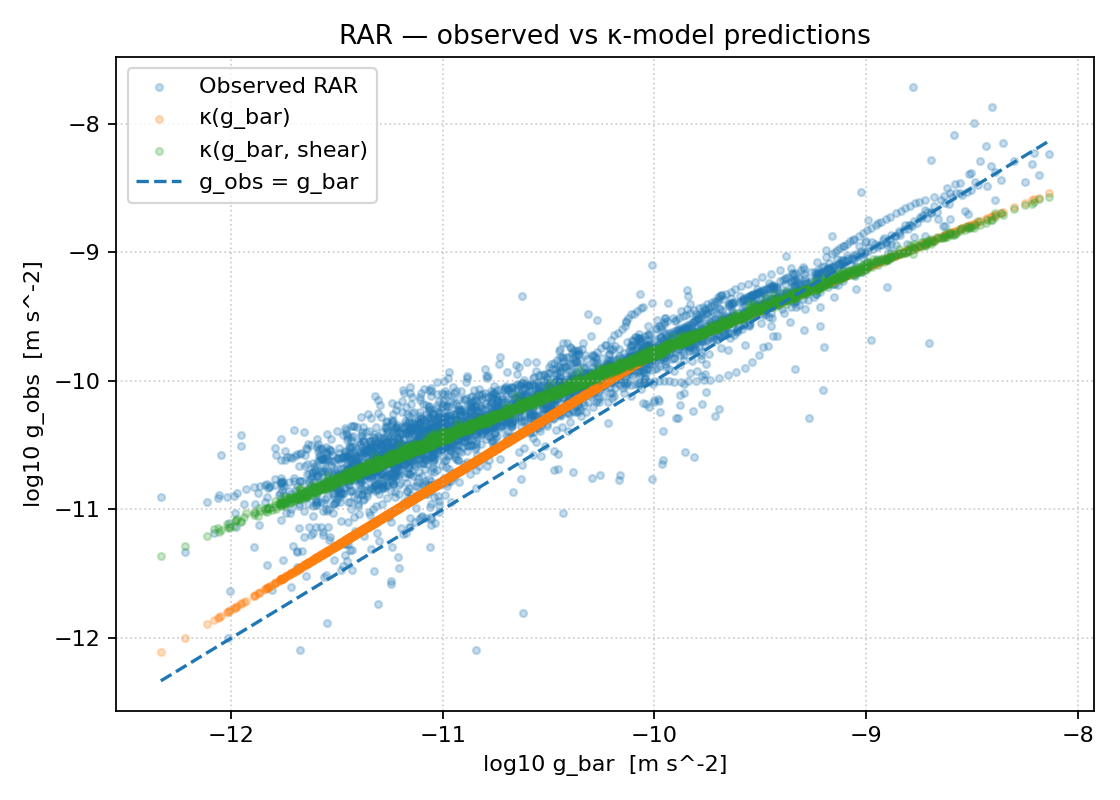
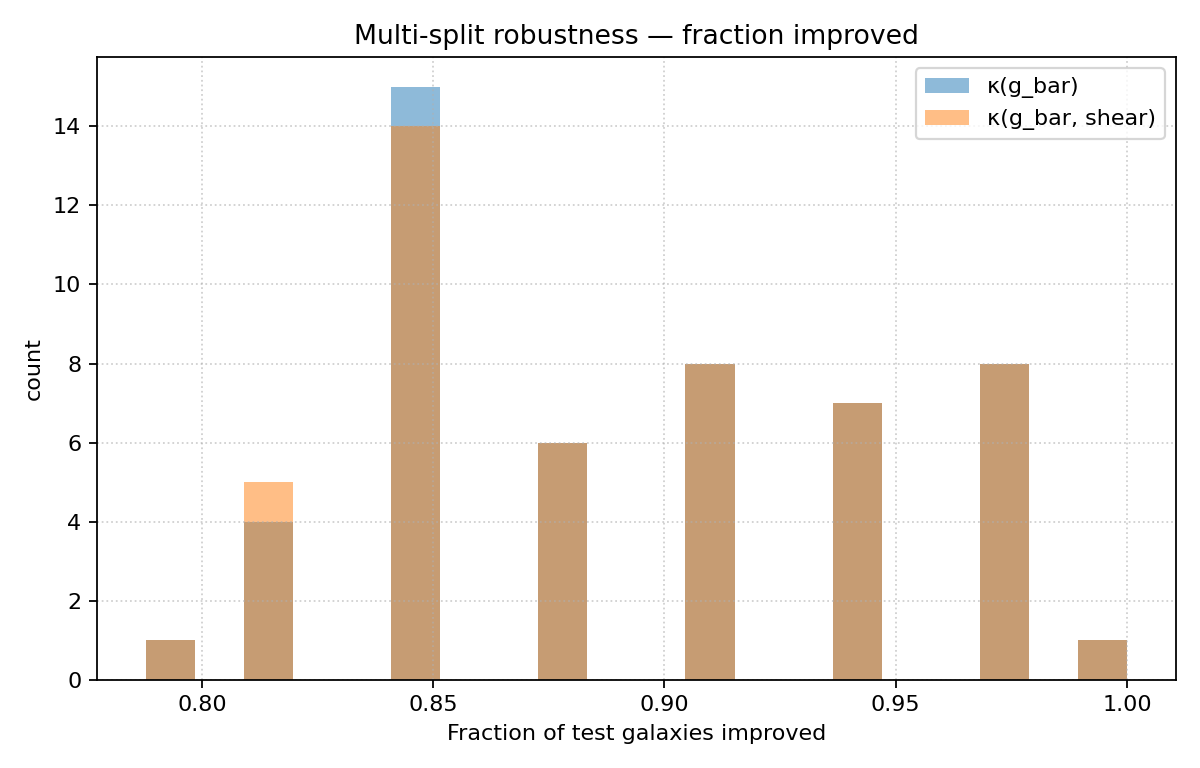
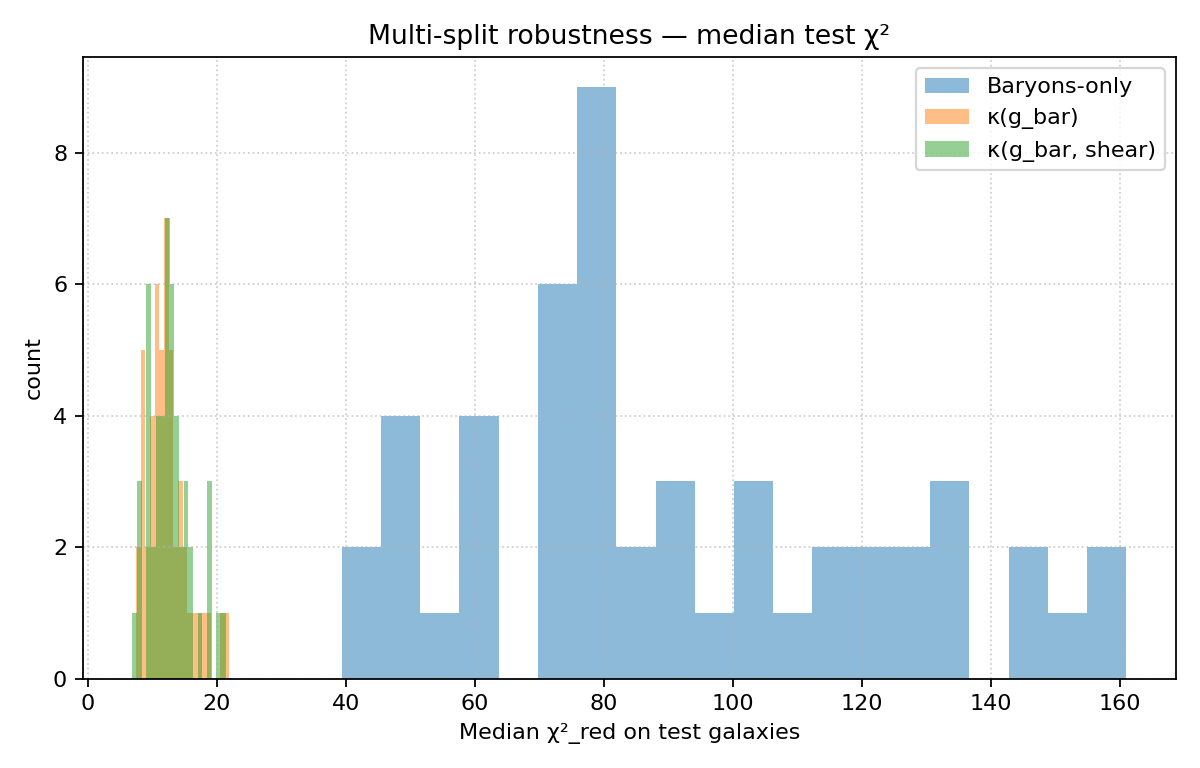
Figures 8-10: Comparison between κ-framework predictions and the observed radial acceleration relation.
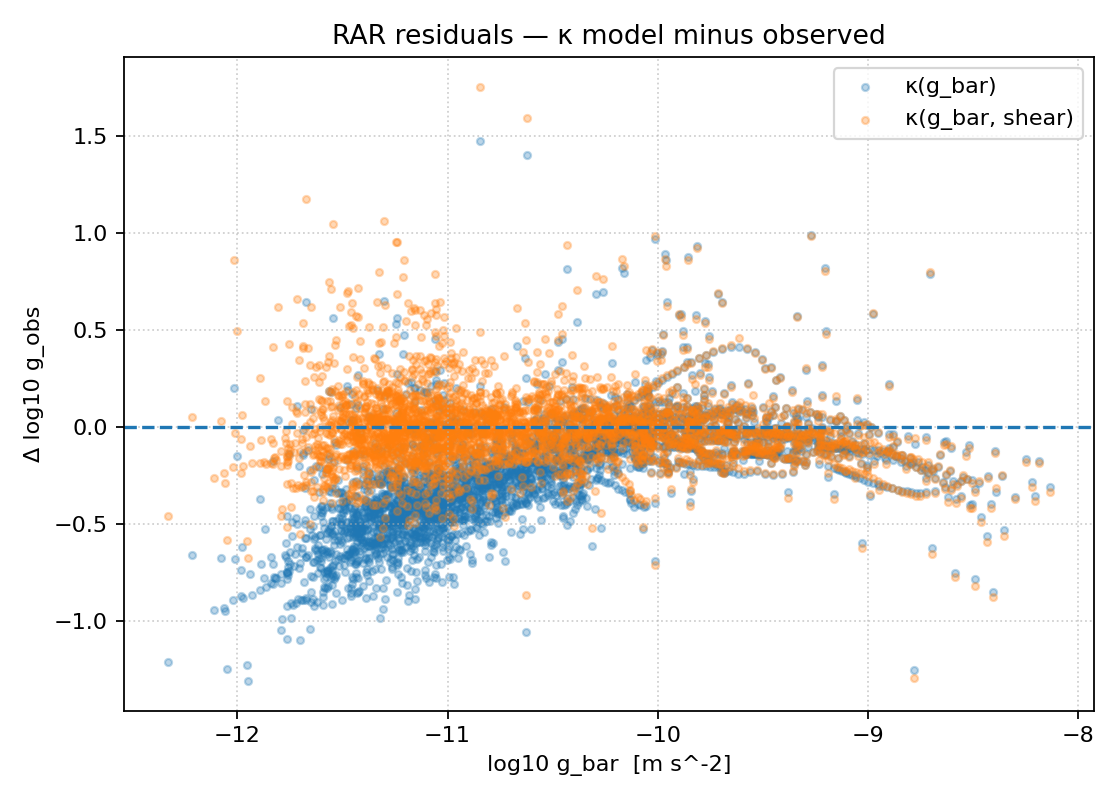
Figure 11: The vertical axis shows the difference between predicted and observed accelerations , plotted as a function of baryonic acceleration . Points represent measurements across the stacked SPARC galaxy sample. The dashed horizontal line indicates zero residual. Both the and models track the observed RAR with relatively small systematic deviations, with the shear-augmented model reducing residual structure in parts of the low-acceleration regime.
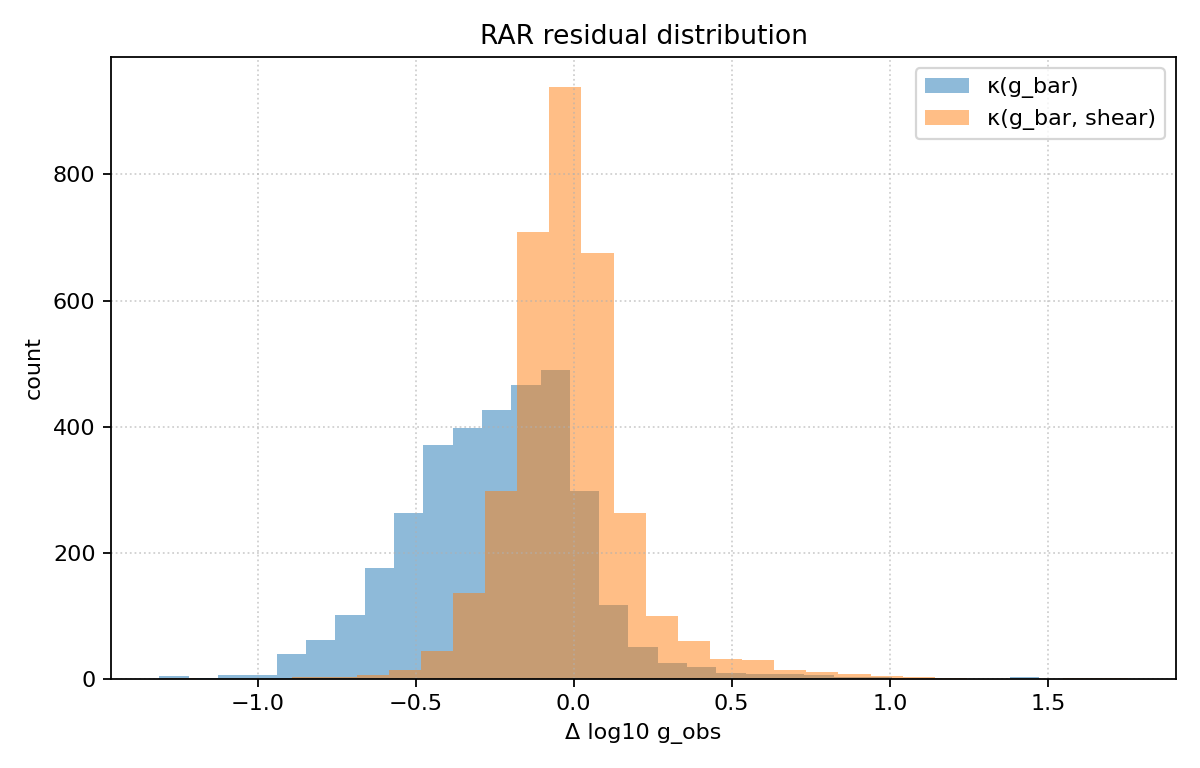
Figure 12: Residuals are concentrated near zero, indicating that the κ-based predictions reproduce the observed radial acceleration relation with relatively small scatter. The inclusion of baryonic shear slightly narrows the residual distribution.
Discussion
The results presented here demonstrate that a simple environmental parameterisation of the form
captures a substantial fraction of the discrepancy between baryonic Newtonian predictions and observed galaxy rotation curves across the SPARC sample. Because the κ-framework writes the observed velocity field as
the quantity can be interpreted as the logarithmic amplification of the baryonic Newtonian velocity field. The empirical relation therefore implies that this amplification scales systematically with baryonic acceleration. This scaling can be rewritten in a form that clarifies its geometric meaning. Converting the base-10 logarithm to a natural logarithm gives
with
Exponentiating yields
Substituting
shows that the observed velocity behaves approximately as a fractional power of the baryonic velocity field with a weak radial dependence. In this sense the κ-framework can be viewed as an effective renormalisation of the Newtonian velocity field driven by the local baryonic dynamical environment.
It is important to emphasize that the κ-framework presented here is empirical. The present analysis does not derive from a fundamental gravitational theory but instead examines whether a simple environmental response can describe the observed phenomenology.
Limitations and Future Work
Several limitations remain.
The current models use simple linear parameterisations and do not include full uncertainty propagation for fitted parameters. Morphological differences between galaxies are not explicitly modelled, and additional environmental variables may be relevant.
Future work may explore more general functional forms for , additional dynamical predictors, and potential theoretical interpretations of the curvature response.
Conclusion
Using the SPARC galaxy rotation curve dataset, empirical profiles derived from observed rotation curves exhibit systematic correlations with baryonic dynamical quantities. A simple relation between and baryonic acceleration provides a predictive model that improves rotation-curve fits across a large fraction of galaxies.
These results suggest that galaxy rotation curves may be describable through an environmental curvature response encoded in . Whether this reflects an effective phenomenological description or points toward a deeper gravitational mechanism remains an open question.
Further observational and theoretical work will be required to determine the physical interpretation of the κ-framework and its relationship to existing models of galaxy dynamics.
References
SPARC: Mass Models for 175 Disk Galaxies with Spitzer Photometry and Accurate Rotation Curves
Lelli, F., McGaugh, S. S., & Schombert, J. M. (2016)
https://arxiv.org/abs/1606.09251The Radial Acceleration Relation in Rotationally Supported Galaxies
McGaugh, S. S., Lelli, F., & Schombert, J. M. (2016)
https://arxiv.org/abs/1609.05917A modification of the Newtonian dynamics as a possible alternative to the hidden mass hypothesis
Milgrom, M. (1983)
https://ui.adsabs.harvard.edu/abs/1983ApJ...270..365M/abstractA Universal Density Profile from Hierarchical Clustering
Navarro, J., Frenk, C., & White, S. (1997)
https://ui.adsabs.harvard.edu/abs/1997ApJ...490..493N/abstractRotational properties of 21 Sc galaxies with a large range of luminosities and radii
Rubin, V. C., Ford, W. K., & Thonnard, N. (1980)
https://ui.adsabs.harvard.edu/abs/1980ApJ...238..471R/abstractRotation Curves of Spiral Galaxies
Sofue, Y., & Rubin, V. (2001)
https://arxiv.org/abs/astro-ph/0010594Modified Newtonian Dynamics (MOND): Observational Phenomenology and Relativistic Extensions
Famaey, B., & McGaugh, S. (2012)
https://arxiv.org/abs/1112.3960Planck 2018 results. VI. Cosmological parameters
Planck Collaboration (2020)
https://arxiv.org/abs/1807.06209Thermodynamics of spacetime: The Einstein equation of state
Jacobson, T. (1995)
https://journals.aps.org/prl/abstract/10.1103/PhysRevLett.75.1260
Further Reading
Environmental Curvature Response in Planetary Dynamics: Solar System Diagnostics of the κ-Framework

Code and Reproducibility
The analysis pipeline used in this study is implemented in Python and processes the SPARC mass-model files directly. All code used to generate the figures and statistical results presented in this work is available as open-source software:
github.com/hasjack/OnGravity/tree/feature/rotation-curve-analysis/python/rotation-curves
This repository includes the full analysis pipeline, data ingestion routines, model fitting procedures, and scripts used to generate the figures presented in this paper.

Please consider funding this research on Research Hub

Content on this site is licensed under a Creative Commons Attribution 4.0 International License